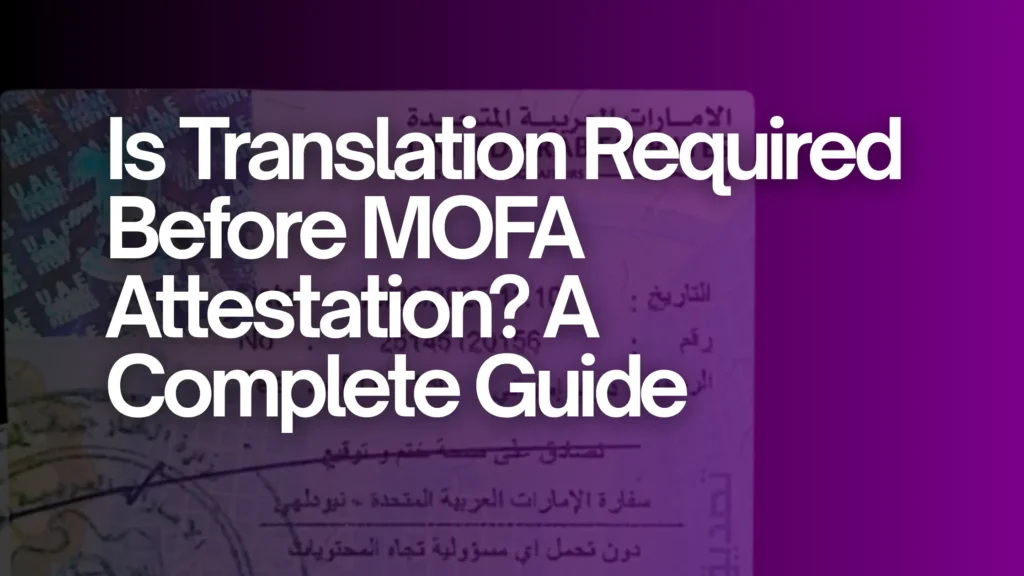
Is Translation Required Before MOFA Attestation? A Complete Guide
Importance of Birth Certificate Attestation in UAE
When preparing documents for official use in the United Arab Emirates, many people ask the same question: Is translation required before MOFA attestation? The answer depends on several factors, including the document’s language, the authority requesting it, and the purpose of the document.
Whether you are applying for a residence visa, employment, higher education, family sponsorship, business setup, or legal procedures, understanding the correct order of translation and attestation can save time, money, and unnecessary delays.
Many applicants mistakenly believe that every foreign document must be translated before it reaches the Ministry of Foreign Affairs (MOFA). In reality, translation requirements vary depending on the document type and the receiving authority.
This comprehensive guide explains when translation is required, when it is not, how translation fits into the attestation process, and how to avoid common mistakes while preparing your documents for use in the UAE.
What Is MOFA Attestation?
MOFA Attestation is the final verification step performed by the Ministry of Foreign Affairs in the UAE. It confirms that a document has already been authenticated by the appropriate authorities in its country of origin.
The ministry does not certify the contents of the document. Instead, it verifies that the signatures and official seals already present on the document are genuine.
Documents commonly requiring MOFA attestation include:
- Educational certificates
- Birth certificates
- Marriage certificates
- Divorce certificates
- Police Clearance Certificates
- Medical certificates
- Commercial documents
- Power of Attorney
- Company incorporation documents
After MOFA attestation, these documents become acceptable for use with many government departments and private organizations in the UAE.
Why Document Translation Matters
Translation ensures that government authorities, employers, educational institutions, and courts can accurately understand the contents of a foreign document.
A properly translated document helps authorities verify:
- Personal information
- Educational qualifications
- Family relationships
- Legal declarations
- Business information
Without an accurate translation, processing may be delayed or rejected if the receiving authority cannot read the original language.
Is Translation Always Required Before MOFA Attestation?
The simple answer is No.
Translation is not automatically required before MOFA attestation.
Whether translation is necessary depends on:
- The language of the original document
- The authority requesting the document
- The intended purpose of the document
- UAE legal requirements
Many English-language documents can complete MOFA attestation without any translation.
However, documents written in languages that UAE authorities cannot process may require certified Arabic translation before submission to the final authority.
This distinction is important because translation is often needed after attestation rather than before it.
When Is Translation Required?
Translation is generally required when documents are issued in languages other than English or Arabic.
Examples include documents written in:
- French
- German
- Russian
- Chinese
- Japanese
- Korean
- Turkish
- Spanish
- Portuguese
- Italian
- Dutch
- Ukrainian
- Romanian
- Polish
If these documents are intended for official use within the UAE, certified Arabic translation is usually required.
Certain government departments specifically request Arabic versions for processing.
When Translation May Not Be Required
Many documents issued entirely in English do not require translation before MOFA attestation.
Examples include:
Educational Certificates
Most university degrees issued in English are accepted without translation during the attestation process.
Marriage Certificates
If issued in English, many authorities accept them without requiring Arabic translation until later stages.
Birth Certificates
English birth certificates are often accepted during attestation.
Police Clearance Certificates
Many English-language PCCs are accepted directly for MOFA attestation.
However, the organization receiving the document may later request an Arabic translation.
The Correct Order: Translation Before or After MOFA Attestation?
One of the biggest misconceptions involves the sequence of document processing.
The standard process is usually:
- Obtain the original document.
- Authenticate it in the issuing country.
- Complete embassy legalization if required.
- Obtain MOFA attestation in the UAE.
- Complete certified Arabic translation if requested by the receiving authority.
It is generally recommended to complete document authentication before translation so the translated copy reflects every official seal and verification already applied.
There are exceptions for certain legal or court-related documents, so professional guidance is always recommended.
Documents That Commonly Require Arabic Translation
Several documents frequently need certified Arabic translation before submission to UAE authorities.
These include:
Educational Documents
- Degree certificates
- Diploma certificates
- Mark sheets
- Academic transcripts
Universities or employers may require Arabic translations depending on the application.
Personal Documents
These include:
- Birth certificates
- Marriage certificates
- Divorce certificates
- Death certificates
- Adoption papers
Family visa applications often require Arabic versions.
Legal Documents
Legal documents usually require certified Arabic translation because UAE courts conduct official legal proceedings in Arabic.
Examples include:
- Power of Attorney
- Court judgments
- Affidavits
- Legal agreements
- Wills
Commercial Documents
Businesses frequently translate:
- Memorandum of Association
- Articles of Incorporation
- Commercial licenses
- Board resolutions
- Financial statements
- Shareholder agreements
These documents may be submitted to licensing authorities, banks, or government departments.
Who Can Perform Certified Translation in the UAE?
Not every translator is authorized to prepare documents for official government use.
Certified translations should be completed by:
- Licensed translation companies
- Government-approved translators
- Legal translation offices recognized by UAE authorities
A certified translator ensures:
- Accurate translation
- Proper formatting
- Official certification
- Acceptance by UAE authorities
Using uncertified translations can lead to rejection and unnecessary delays.
Common Mistakes Applicants Make
Many applicants unintentionally slow down their attestation process by making avoidable mistakes.
Translating Too Early
Some applicants translate documents before completing authentication.
If changes are made during attestation, the translation may become invalid.
Using Uncertified Translators
Machine translations or freelance translators without certification are often rejected.
Assuming Every Document Needs Translation
Not all English-language documents require Arabic translation.
Translating unnecessarily increases costs.
Ignoring Authority Requirements
Different organizations have different documentation requirements.
An employer’s requirements may differ from those of immigration authorities or universities.
Submitting Poor-Quality Copies
Illegible documents create translation errors and processing delays.
Always provide clear, complete originals whenever possible.
Translation Requirements for Popular UAE Applications
Employment Visa
Many employers accept English educational certificates during attestation but may later request Arabic translations for HR records or labor processing.
Family Sponsorship
Marriage and birth certificates frequently require Arabic translation before submission to immigration authorities.
University Admission
Educational institutions sometimes accept English documents without translation, depending on their internal policies.
Business Setup
Commercial documents often require certified Arabic translation before registration with government authorities.
Court Proceedings
Legal documents almost always require Arabic translation because Arabic is the official language of UAE courts.
Can You Translate a Document Yourself?
Self-translated documents are generally not accepted for official government purposes.
Government departments typically require translations prepared by certified professionals.
Even if your translation is accurate, it may still be rejected because it lacks official certification.
Professional translation ensures consistency, legal compliance, and official recognition.
How Long Does Translation Take?
Translation timelines depend on:
- Document length
- Technical terminology
- Number of pages
- Language pair
- Urgency
Simple certificates are often translated quickly, while lengthy legal or commercial documents may require additional time for review and certification.
Planning ahead helps prevent delays during visa or legal procedures.
Benefits of Using Professional Attestation and Translation Services
Handling translation and attestation independently can become confusing, especially when multiple government authorities are involved.
Professional service providers help by:
- Reviewing document requirements
- Identifying whether translation is necessary
- Managing document authentication
- Coordinating embassy legalization
- Arranging certified translations
- Completing MOFA attestation
- Reducing processing errors
Working with experienced professionals minimizes the risk of rejection and ensures that documents follow the correct sequence.
If you need complete assistance with Attestation Services in UAE, professional experts can guide you through every stage, from document verification to final submission.
Similarly, specialized MOFA Attestation Services in UAE help ensure your documents meet current government requirements while reducing unnecessary delays.
Frequently Asked Questions
Does every document require Arabic translation before MOFA attestation?
No. Many English-language documents can complete MOFA attestation without translation.
Can I translate my own documents?
For official UAE use, self-translated documents are generally not accepted.
Should translation happen before MOFA attestation?
In many situations, translation is completed after attestation. However, requirements vary depending on the receiving authority.
Who decides whether translation is required?
The government department, employer, university, court, or organization requesting the document determines whether translation is necessary.
Can English documents be used directly?
Many English documents are accepted during attestation, although some authorities later request certified Arabic translations.
What happens if I submit an uncertified translation?
The receiving authority may reject the document and request a certified legal translation, resulting in additional costs and delays.
Conclusion
So, is translation required before MOFA attestation? In most cases, the answer is no. Translation is not a universal requirement before the MOFA process. Instead, the need for translation depends on the language of the document and the requirements of the authority that will ultimately receive it.
English-language documents often proceed through MOFA attestation without translation, while documents issued in other languages usually require certified Arabic translation for official use in the UAE. Following the correct sequence—authentication, attestation, and then translation where necessary—helps avoid costly mistakes and processing delays.
Before submitting your documents, always verify the specific requirements of the receiving authority. If you are unsure about the correct procedure, choosing experienced Attestation Services in UAE can simplify the process and ensure your paperwork is handled correctly. For documents requiring final authentication by the Ministry of Foreign Affairs, reliable MOFA Attestation Services in UAE can help you complete the process efficiently and with confidence.