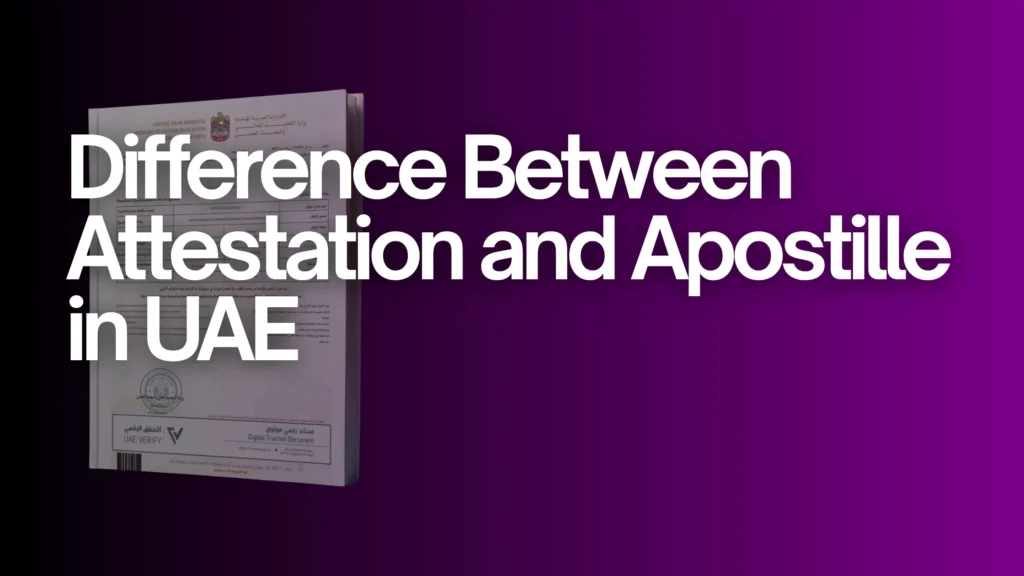
Difference Between Attestation and Apostille in UAE
Understanding document verification is essential in the UAE.
Many people confuse attestation and apostille.
Both confirm document authenticity.
But they apply in different legal systems.
If you plan to work, study, or start a business in the UAE, knowing the difference saves time and cost.
What is Attestation in UAE?
Attestation is the process of verifying documents through multiple authorities.
It confirms that a document is genuine and legally valid in the UAE.
This process applies to countries that are not part of the Hague Convention.
The UAE follows this system.
Attestation usually involves:
- Notary verification
- Home country government approval
- UAE embassy stamping
- MOFA (Ministry of Foreign Affairs) attestation
Documents commonly attested:
Each step adds a layer of validation.
This ensures the document is accepted by UAE authorities.
Using a reliable attestation service in uae helps speed up the process.
It also reduces rejection risk due to errors.
Attestation is mandatory for:
- Employment visas
- Family sponsorship
- Higher education
- Business setup
Without attestation, documents are not legally recognized in the UAE.
What is Apostille?
An apostille is a simplified document legalization process.
It is accepted by countries that are part of the Hague Apostille Convention.
Instead of multiple steps, a single certificate is issued.
This certificate confirms the document’s authenticity.
Key features of apostille:
- One-step verification
- Issued by a designated authority
- Accepted across member countries
It includes:
- Signature verification
- Seal authentication
- Issuing authority details
However, the UAE is not part of the Hague Convention.
So apostille alone is not valid in the UAE.
Documents with apostille still need further attestation.
Professional apostille services in uae can guide you if your document originates from a Hague member country.
This ensures smooth acceptance in the UAE.
Key Differences Between Attestation and Apostille
Attestation and apostille serve similar purposes but differ in process and acceptance.
Main differences:
- Process
Attestation involves multiple steps.
Apostille is a single-step process. - Validity
Attestation is required for UAE use.
Apostille is valid only in Hague Convention countries. - Authorities Involved
Attestation includes embassy and MOFA.
Apostille is issued by one authority. - Time Required
Attestation takes longer due to multiple stages.
Apostille is faster. - Usage
Attestation is used in the UAE and non-Hague countries.
Apostille is used in Hague member countries.
Understanding these differences helps you choose the correct process.
When Do You Need Attestation in UAE?
Attestation is required when submitting foreign documents in the UAE.
You need attestation for:
- Job applications
- Residence visas
- Family sponsorship
- School admissions
- Business licensing
Employers often request attested certificates.
Government departments also require them.
Without attestation, applications may be rejected.
Typical documents include:
- Degree certificates
- Birth certificates
- Marriage certificates
- Power of attorney
Each document must pass through all required stages.
Using an experienced service provider ensures:
- Faster processing
- Correct documentation
- Compliance with UAE laws
Attestation is not optional in most official cases.
It is a legal requirement.
When is Apostille Required?
Apostille is required when documents are used in Hague Convention countries.
Examples include:
- Studying abroad
- Working in Europe
- International business transactions
If your document is issued in a Hague country, it may already have an apostille.
But for UAE use:
- Apostille alone is not enough
- Additional attestation is required
This is where confusion often happens.
People assume apostille is globally accepted.
It is not.
Always check destination country requirements before processing documents.
Step-by-Step Process for Attestation in UAE
Document Preparation
Start with original documents.
Ensure:
- No damage or errors
- Correct personal details
- Supporting documents are ready
Translation may be required for non-English documents.
Clear documentation avoids delays.
Government & Embassy Verification
The document goes through several authorities:
- Notary public
- Home country ministry
- UAE embassy
- UAE MOFA
Each stage confirms authenticity.
Skipping any step can lead to rejection.
Professional services manage this process efficiently.
Apostille Process Explained
Issuing Authority
Apostille is issued by a designated government body.
Examples:
- Ministry of Foreign Affairs
- Department of State
The authority verifies the document and attaches the apostille certificate.
This certificate confirms authenticity internationally within member countries.
Valid Countries
Apostille is accepted only in Hague Convention countries.
Examples include:
- USA
- UK
- France
- Germany
The UAE is not on this list.
So apostille must be followed by attestation for UAE use.
Which One Should You Choose?
Your choice depends on where the document will be used.
- For UAE → Attestation is required
- For Hague countries → Apostille is enough
If unsure:
- Check destination country rules
- Consult a professional service
Choosing the wrong process causes delays.
It may also lead to document rejection.
Common Mistakes to Avoid
- Using apostille for UAE without attestation
- Submitting incomplete documents
- Ignoring translation requirements
- Choosing unverified service providers
Avoid these errors to save time and cost.
Always verify requirements before starting the process.
Final Thoughts
Attestation and apostille are both essential document verification methods.
But they are not interchangeable.
In the UAE, attestation is mandatory.
Apostille alone is not sufficient.
Understanding this difference helps you:
- Avoid delays
- Ensure compliance
- Complete processes smoothly
For faster results, use trusted services and follow correct procedures.
Get Your Documents Attested Quickly & Hassle-Free
Start your process today with trusted experts. Apply Now